

Last week I sent an email to Harvard students on the first day of class that outlined my areas of focus for the College in the upcoming academic year. One of those three areas of focus was developing a set of guidelines and policies for AI use in the classroom. In that email, I argued for a “barbell” approach to AI usage – either ban it in a way that is realistically enforceable, or accept the fact that students are going to use it and build your assignments around that reality. Optimistically, you might be able to use AI to improve teaching and learning, even in writing-intensive courses.
Tyler Austin Harper posted a part of my email on X, and it caused quite a stir. He appears to think that we are planning to destroy writing education and replace it with AI.
That is not true – at all!
At Harvard we have a mandatory expository writing course that has been in existence since 1872, and our writing center continues to provide peer tutoring. In a typical semester we have about 1,000 tutoring sessions. This summer, the center was consolidated into the Academic Resource Center as part of a broader restructuring, but the tutoring work continues without interruption.
Teaching students how to write well is one of the most important things we do at Harvard, and I believe good writing and clear thinking will be even more important as AI becomes a bigger part of our lives. If anything, I expect us to pay more attention to writing in coming months and years. I think it is bad to have AI do your writing for you, because writing is thinking, as many others have said. Whenever I have an idea, I always try to write it out, which exposes the holes and flaws in my reasoning and gives me new ideas to build on.
So why the misunderstanding? Here is the entire section about AI from my longer email, with the part that Tyler excerpted in bold:
AI use policies
One of my goals last year was to understand how AI was affecting teaching and learning at Harvard College. This year I believe we must act. My goal is to produce a set of advisory guidelines on AI usage in Harvard College courses by the end of the academic year. This will require extensive consultation and input from faculty, staff, and students, both because faculty have the expertise to judge what is best for their class and because this is a fast-moving landscape and no one has all the answers.
Still, in the spirit of starting the conversation, here are my initial thoughts based on emerging research and many conversations with our faculty. I favor a “barbell” approach to AI in the classroom: actively encouraging AI usage where it can deepen learning, and at the same time, AI-proofing assessments that are designed to demonstrate mastery.
Many larger classes with take-home problem sets may want to shift more grading weight toward in-person quizzes and other supervised assessments. We may want to give more seated “blue book” final exams: three-hours, with pen-and-paper. Take-home exams and problem sets are no longer a sustainable way to assess mastery, and when coupled with unenforceable AI bans they create a difficult dilemma for students who don’t want to cheat but also fear falling behind to their classmates. Just as Odysseus bound himself to the mast, we must build restraints in examinations to avoid temptation.
Many other classes at Harvard are writing-intensive and/or project-based, and a different approach is needed for papers and other assignments that are too meaty to fit within a proctored exam window. Here I would modestly suggest AI acceptance, or even encouragement. We would all benefit from getting out of the AI-detection business because it damages trust between faculty and students. We might instead go further by asking you to “embody” the expertise you’ve developed, perhaps through a presentation or oral defense for classmates, teachers, and clients.
Let me say again – these are thoughts, not statements of policy. I offer them in the spirit of moving us toward a mission-aligned AI use policy at the College by the end of the academic year.
The email was meant to start a conversation, not to set policy. It’s also not AI boosterism. In fact, I hope we can make serious progress toward keeping AI out of the classroom through a return to proctored, “blue book” exams. Some of this can be accomplished in writing courses if an assignment fits in a three-hour window. I took plenty of writing-heavy courses where the final exam consisted of pen-and-paper essays. In many cases though, we still want to give longer take-home writing assignments.
So why would I suggest “AI acceptance, or even encouragement”? I am old enough to have developed my writing and thinking skills before temptations like AI existed. It is relatively easy for me to put the AI down and do the writing on my own. Younger people who have always had access to AI may need more help, and I believe it is up to us to provide it, rather than pretending that nothing has changed.
Many college classes around the country right now are giving take-home writing assignments while banning AI and counting on students to comply, without any realistic enforcement mechanism. I believe this is deeply unfair. Students know that their classmates are facing the same temptations, so they either violate the course policy (bad) or behave with integrity while feeling that they are being disadvantaged relative to their less-honest peers (good, but feels bad).
Of course, we can loudly insist that they should know better, that in the long run they will benefit from doing the work. I believe that is true. But I also think we should make it easier for students to comply. And that is why I linked to Kyle Saunders’ marvelous essay about AI course policies. In his words:
In this class, every graded assignment is either “AI allowed” (encouraged on the papers, “OK” for the online quizzes, because, well, they’re online and I can’t tell if students are using it or not) or “AI Prohibited.” There is no middle lane.
That vague middle is the problem. “You may use AI for brainstorming but not for drafting” sounds reasonable on its face, but means very little at 11pm in a dorm room. Further, what counts as brainstorming? Where does the outline stop and a draft actually start?
That line moves depending on who is asking, and I don’t think students (or anyone) should pay for that ambiguity. I’d rather draw the line somewhere I can actually defend and shine a spotlight on it so no one misses it.
…..
So, why “Encouraged” and not just “allowed”
To answer that question, I start with what prohibition actually does. It sure as heck doesn’t produce a class that isn’t using AI. It produces a class where some students are using it, quietly and undetectably, and others aren’t because they took the rule seriously. That splits the class in two, and it splits in exactly the wrong way. The students who follow the rules end up competing against invisible assistance and the efficiency gains that come with it, and their integrity functions as a handicap. That’s the kind of policy that makes no sense to me. Punishing the conscientious and rewarding the willing to chance it is a bad policy, whatever its intentions.
Professor Saunders said it better than I could. In hindsight, I wish I had developed these arguments more fully in my email to students, but it was already rather long for a beginning-of-school missive.
Is Pangram a panacea?
Pangram is an AI text detector that identifies what percentage of a text is likely written by an LLM. I think it is good that we have Pangram and other technologies for detecting AI writing. Still, as I see it, they have an important conceptual limitation.
Pangram’s algorithm identifies AI writing based on patterns in grammar, syntax, and word choice, so it can identify cases where a student has AI do the writing for them. But again, writing is thinking, and we assign writing in part because we want students to be clear thinkers. Even with Pangram, it is still possible to have AI do the thinking for you.
I gave ChatGPT this prompt – “write a 100 word essay arguing that Ohio State should be the top ranked college football team in the country this year.”
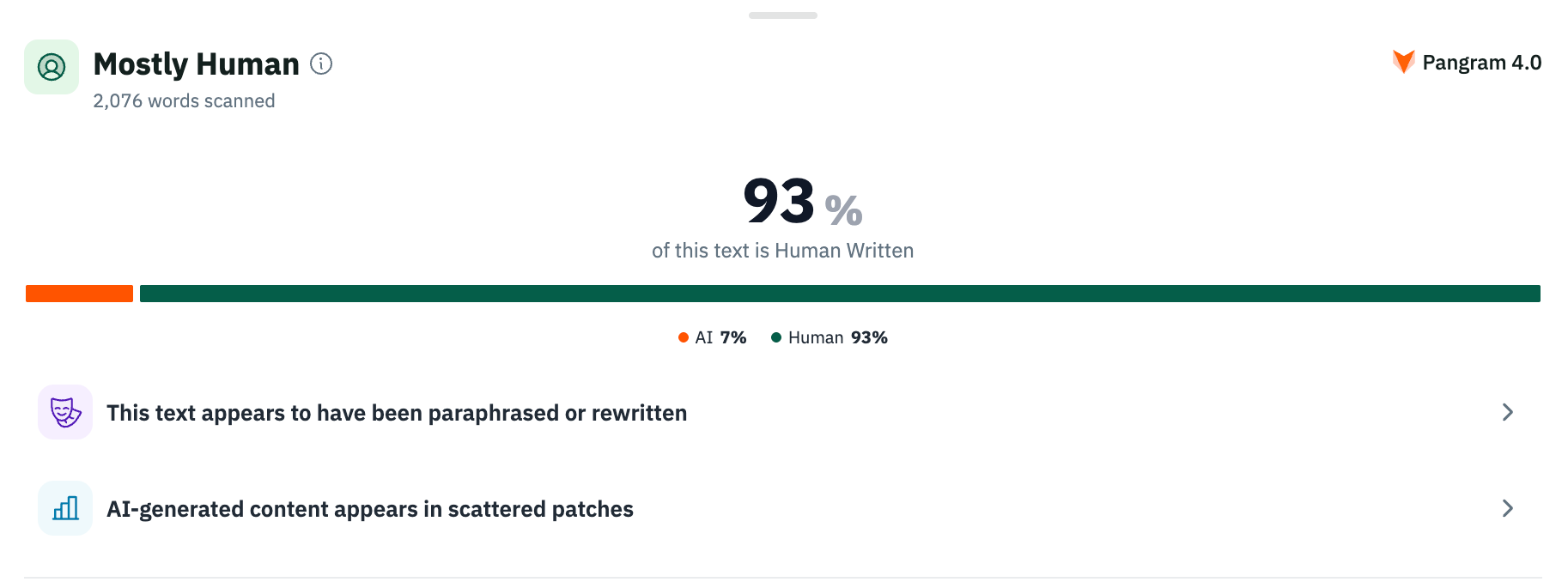
Here was the result, which Pangram flagged as 100% AI:
Ohio State should be the top-ranked college football team in the country this year because the Buckeyes have both the résumé and the talent to justify it. They entered the season ranked No. 1 and immediately looked the part, overwhelming Ball State 56–3. Ohio State combines elite recruiting, exceptional depth, explosive skill players, and a defense capable of controlling games from the opening snap. Other contenders such as Oregon, Georgia, and Texas are formidable, but none has done enough to displace the Buckeyes. Until Ohio State shows otherwise, the defending standard of excellence deserves to remain college football’s number-one team.
I then rewrote the argument myself:
The Ohio State Buckeyes deserve to be the #1 ranked college football team in the country so far this year. They were ranked #1 in the preseason, they easily beat Ball State 56-3 in the opening game, and they probably have the most talented team in the country. Most of their skill position players are returning after successful years last year, their recruiting class was outstanding, and they have a suffocating defense that never quits. While a few other schools like Oregon and Texas – maybe Georgia too – have legitimate claims to be ranked #1, none of them have done enough to jump ahead of the Buckeyes, at least not yet. Ohio State have earned their #1 ranking based on their history of excellent performance and early returns in the first game.
Pangram judged this second paragraph as 100% human written. But I think we can all agree that none of the ideas above are my own (although as a Buckeye myself, I do happen to agree with them!) Extrapolating this outward, I expect that some people will respond to Pangram detection by asking AI to write the essay first and then rephrasing the ideas to give them a human sheen.
AI encouragement doesn’t mean using AI to write for you
Still, I don’t think we should give up on teaching writing. We just need to design assessments better to protect the thinking that good writing requires. Many faculty here and elsewhere have already answered the challenge. The Bok Center for Teaching and Learning at Harvard has lots of great advice about how to scaffold assignments to make them more AI-resilient, including asking for outlines and rough drafts, using AI to get periodic feedback, and coupling take-home essays with in-person comprehension checks, presentations, and discussions. Bok Center staff meet with faculty to give them advice and ideas for how to adapt assignments to AI use.
Speaking personally, I don’t use AI to write for me, but I do use it as an objective peer reviewer that helps me refine my prose and surface factual mistakes in my arguments. A recent study at Carnegie Mellon found that student writing improved after receiving either generative AI or peer feedback when students completed a first draft on their own - with similar impacts for AI and peer feedback. The study found even larger gains than the peer-feedback group when students got repeated AI feedback. This is consistent with other work I’ve seen on generative AI tutoring. The key is that students first complete the assignment without assistance – doing the thinking independently – and then use AI to refine and improve their work.
You could imagine a writing assignment where students submit an “AI proof” first draft under observed conditions and then iterate with both the teacher and the AI to refine and improve their ideas. This is the sense in which we can encourage AI use in the classroom while not allowing AI to write – or think – for us. The main purpose of writing assignments is to develop the writer.
This is an important addition to the conversation and I very much appreciate it. As someone who now spends most of his time working with instructors and institutions on this challenge, it's important to air as many perspectives as possible and remain open to the fact that the challenge is dynamic, not static.
I think there's a number of areas worth exploring further.
1. It is indeed possible to get students doing out of class writing without using AI, but it requires orienting the work of the class around "learning," as opposed to performance on an assessment. The underlying transactional model of schooling must be surfaced and then explicitly disrupted. I think we all agree that all things considered, students do want to learn, but both the structure of schooling and life frequently throw up obstacles to that goal. At the very least we should try to make the structure of school as closely associated with learning as possible.
2. Orienting writing around learning requires a rethink of both why we assign writing and how we grade it. I won't clog your comments with my full approach, but I believe the goal of a writing course should be to build a writing practice - the skills, knowledge, attitudes, and habits of mind of writers. Your writing practice is on display when you discuss how you think it's important to do your own writing to work out your ideas. This is an ingrained attitude that serves you well. Students, even highly prepared college students, have never considered their work in school in this dimension. But, if we make this kind of development explicit to the purpose of the assignment/experience, they will understand why a particular instructor may be requiring them to do the work in the absence of AI automation.
If we rethink grades so it values the learning and practice-building, students won't be able to use AI to avoid the very things that are being assessed.
This doesn't guarantee results and engagement, but nothing does or ever has. Such is the lot of the college instructor.
3. In class assessments are perfectly valid, but they don't really assess someone's ability to write, at least not in the deep sense you're talking about.
4. AI is not "an objective peer reviewer." The process by which an AI model generates feedback on a piece of writing is entirely distinct from what happens when soliciting feedback from a peer. This does not preclude AI feedback from being useful, but I believe this distinction matters, particularly when we think of "peer review" as an exercise in professional judgment. A non-thinking (in the human sense) AI model does not exercise this judgment.
One thing I try to hold in my mind always is that the people who are making the most productive use of AI in their research and writing processes without falling prey to de-skilling or what I call "self-alienation" (the steady outsourcing of your work to automation) are "adults" who (with very few exceptions) had zero access to this technology prior to November of 2022. The "practices" that allow them to make this productive use were established in the absence of the technology.
Now, it's possible that these capacities can be accelerated by introducing AI earlier, but as of this time we have no evidence to support this, and lots of evidence pointing towards the risk of both de-skilling and demotivation in using AI in younger learners. We are many years and much exploring away from even having a solid foundation of what AI literacy is. (See MIT's Justin Reich on this front.)
I don't know anyone who believes we should "ignore" AI, but I also think we do ourselves and our students a disservice to retreat to vague notions of "inevitability" when we have lots of evidence that learning experiences in AI's absence have great value, including when it comes to someday making productive use of AI.
Good clarification; you caused a stir! This is a balanced, reasonable approach to a problem that is befuddling every educational institution.