
Remote work containerized the office, paving the way for AI
The pandemic unbundled junior jobs and made rote white-collar tasks a machine-readable commodity

Hello, Forked Lightning readers! Today I weigh in on a raging debate – is AI responsible for the decline of entry-level job opportunities for new college graduates?
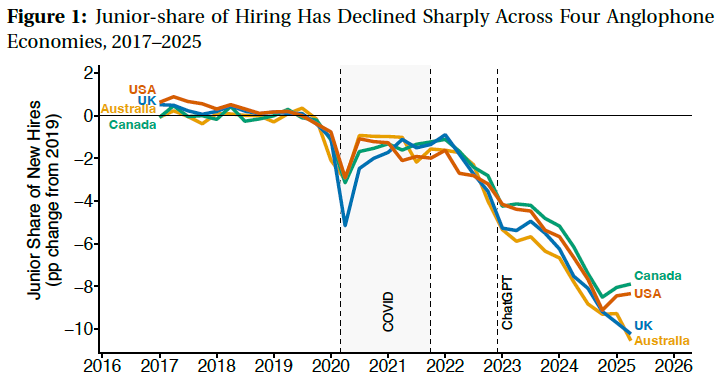
A recent paper by Peter John Lambert and Yannick Schindler argues that remote work may be the real culprit. There are some complicated econometrics in the paper, but the key point is actually very simple. The relative decline in junior hiring started in early 2022, several months before ChatGPT was released in November. Figure 1 from their paper (reproduced below) shows the simple descriptive evidence. In four different countries, the share of new hires that are junior was already down by about 5 percentage points relative to 2019 on the first day that ChatGPT was available to the public.
The other key point is that the occupations most exposed to AI are also most exposed to remote work. Figure 2 from their paper shows the scatterplot of AI and WFH exposure.1 The correlation is 0.77, about the same as parent and child height.
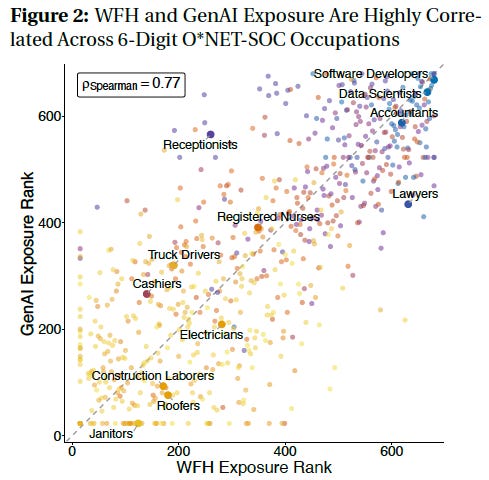
The paper then runs a statistical horse race between work-from-home and AI exposure and finds that work from home explains the data better.
One simple way to think about it is that the decline in junior hiring is larger in jobs below the 45-degree line (e.g. lawyers) than above it (e.g. receptionists).2 As a final test, the authors study actual WFH adoption at the firm level and find results that are broadly similar with the occupation-by-state-by-time variation. Their bottom line is that WFH is a much better predictor of the decline in junior hiring than generative AI exposure.3
On the one hand, I am not surprised to see WFH explain the decline in junior hiring better than AI. People underrate the speed and scale of the office exodus. WFH increased from 5% of all workdays in the U.S. in 2019 to more than 60% during the pandemic and remains at 25% as of May 2026, a permanent fivefold increase. Also, the timing doesn’t really make sense for AI to be the main culprit. Although the November 2022 release of ChatGPT is often used as the “event” in an event study design, only 5.4% of U.S. firms had adopted AI by early 2024. The release of Claude Code in May 2025 – and the rapid growth in agentic AI tools - is a much better “event” candidate.
On the other hand, it’s hard to completely dismiss the idea that AI threatens entry-level jobs. Tech executives are explicitly telling journalists that their goal is the automation of entry-level work, and AI was cited in 40% of all layoff narratives in May 2026.4
News articles also adopt the horse race frame, with titles like “What if remote working, not AI, is to blame?” and “Remote work – not AI – has sidelined recent college graduates”. The real answer is that they have worked in sequence - first remote work, then AI - and each exploits distinct vulnerabilities in the entry-level office job.
Junior hiring is capex, not opex
Prior to the pandemic, large professional services firms hired hundreds of graduates each year and put them to work building Excel models and preparing presentations. In 2019, the consulting firm Deloitte trained nearly 10,000 college graduates and 4,300 interns through a $300 million program called Deloitte University. PwC, Bank of America, and Accenture had similar programs. This is not an obvious strategy in a competitive business environment, because new college graduates typically don’t know very much about business and aren’t immediately useful.
The trick is to think about entry-level hiring like a capital investment, where costs are paid upfront and the benefits accumulate over time. Today’s trainees are tomorrow’s senior leaders. Nicholas Lemann’s classic piece “The Kids in the Conference Room” about McKinsey illustrates how white-collar service firms intentionally create talent pipelines and structure entry-level work to prepare smart junior associates for senior management positions one day.
The entry-level white-collar job bundles rote tasks and apprenticeship together. Remote work unbundles these two functions. Prior to 2020, the physical layout of these firms was memorably described by Salesforce as big skyscraper offices and a “sea of desks”. Financial firms packed junior and senior employees together on dense, cacophonous trading floors. Even though we are now back in the office, the pre-pandemic layout never returned. Big firms like Goldman and JP Morgan are touting hybrid work arrangements and new office layouts with flexible workspaces, breakout rooms, and a focus on employee wellness.
These are all good things in a vacuum. But the lack of physical proximity probably harms junior employees, who need dense feedback loops to learn. Natalia Emanuel, Emma Harrington, and Amanda Pallais have a fantastic forthcoming QJE paper that studies the impact of both the 2020 office closure and a 2023 return-to-work mandate on software engineers in a Fortune 500 company. They find that sitting near coworkers increases feedback and code comments, mainly from senior to junior employees. The author team even hired external engineers to rate the feedback and found that it was helpful and substantive and had long-run positive impacts on code quality. Importantly, the mechanism is physical proximity - being in a different building on campus has the same impact on feedback as being on a Zoom screen.5
Another important finding is that senior engineers wrote more code when working from home, because they weren’t spending time mentoring junior colleagues. Junior hiring and mentoring is costly in the short run, but pays off as future senior talent.
Remote work creates a paper trail
The rapid retreat to remote work during the COVID-19 pandemic also forced firms to codify office processes, turning tacit office work into customer service tickets, shared documents, Slack threads, pull requests, data dashboards, and CRM platforms. Even though these digital records were created before generative AI was widely available, they paved the way for automation. A particularly vivid illustration comes from this 2020 letter to JP Morgan shareholders, which talks about how the pandemic shifted the bank toward a “multi-year program to modernize our technology infrastructure” and “become a digital-first organization.” There are many other examples.
One useful analogy is the “containerization” of global shipping. Before containerization goods were crammed into ship hulls in crates or as loose cargo, an unwieldy and labor-intensive process. In 1956 an American trucking tycoon named Malcolm McLean started shipping everything in equally-sized metal boxes. Standardizing the form and size of shipping containers allowed them to be moved, routed, stacked, and tracked through an increasingly automated system. Similarly, remote work forced firms to standardize previously tacit office routines.
Buy vs. build and the Hollywood studio system
At the same time, WFH greatly broadened labor markets and increased competition for jobs during a historically tight post-pandemic labor market. In 2019, less than four percent of workers lived more than 50 miles away from their workplace. Today the share of new hires living more than 50 miles away exceeds 12 percent and is even higher for highly-paid workers in finance, tech, and professional services. WFH expands the pool of experienced workers that firms can “buy” on the open market, lessening their incentive to “build” talent internally, especially when it’s harder to mentor junior workers remotely. In addition, firms’ willingness to train junior workers was probably diminished by the “Great Reshuffling” of 2022, when quits and vacancies were at an all-time high. Adding it all up, the pandemic and immediate aftermath was a perfect storm that unbundled junior white-collar jobs and broke the career ladder.
There is an interesting historical parallel to the Hollywood studio system of the 1930s and 1940s, when the “Big Five” studios invested heavily in discovering and developing talent because they could internalize the upside when someone became a star. Famous actors like Clark Gable, Bette Davis, Humphrey Bogart, and Katharine Hepburn were signed early in their careers to long-term, fixed wage contracts that ceded financial upside to the studio. A 2020 Journal of Law and Economics paper by Hanssen and Raskovich shows how this system exploited actors but also created a talent development pipeline, and also how two court decisions unraveled it over time. Once contracts became project-based rather than long-term, studios casted more established stars over unproven talent. The studio system was bad for stars, but good for star-making.
There are many other examples of “buy” vs. “build” dynamics, such as the impact of social media on the music industry or how the transfer portal in college athletics reduces high school recruiting.
If remote work containerized office tasks, AI is the crane
To recap, junior white-collar labor has historically been a bundled product that combines rote knowledge work with apprenticeship training. The pandemic broke the bundle apart on both the cost side (harder to mentor junior employees online) and the revenue side (expanded pool of experienced labor). Making matters worse, AI turns out to be a low-cost substitute for rote knowledge work, which further reduces the value of a junior employee. Luis Garicano calls this the “AI Becker problem.” Nobel laureate Gary Becker famously pointed out that companies underinvest in general skills training because their rivals can poach employees after the fact, a.k.a. the Hollywood studio problem.
Garicano and Rayo (2026) formalize this intuition with a model of career progression in hierarchical firms where AI can substitute for junior job tasks. As AI becomes more capable the apprenticeship model becomes less viable, because junior employees are less able to “pay back” their training costs when AI substitutes for more of their work.
I like their model a lot, but it doesn’t pin down AI as the main cause of the collapsing career ladder. We know that remote work increases training costs, and in the model higher training costs have a very similar (but not identical) impact to more capable AI. In fact, automation-biased AI and variable training costs are complements in the Garicano-Rayo model. This matches the empirical results from a nice paper by Gregor Schubert, which shows that firm who adopted remote work technology during the pandemic were subsequently more likely to make organizational investments in AI. Remote work made office tasks machine-readable, which unbundled junior jobs and paved the way for automation.
And yet….I’m skeptical of the conclusion that AI is intrinsically biased against young workers. It hinges on a “just-so” argument that AI is good enough to replace junior-level tasks but not good enough to replace senior management. If strong AGI is coming, this can’t be an equilibrium. Stress may appear now in the junior rung of the corporate ladder, but it will eventually move upward.
The AI measure is from Eloundou et al (2024); WFH is from Hansen et al (2023), who classify the share of job postings by occupation that offer one or more days of remote/hybrid work.
The analysis is much more sophisticated than this, because they are also using time-, country- and state-level variation.
This is also consistent with a NY Fed brief by Emanuel, Harrington, and Pallais (2026), who estimate that remote work can explain 64% of the increase in unemployment for young college graduates over the five-year period spanning pre- to post-pandemic.
A recent paper by Maasoum and Lichtinger goes beyond the event study approach to identify the exact moment that firms implement AI and finds junior employment declines shortly thereafter.
Another recent paper studies WFH at a data center in India and finds very similar results, with faster learning among new employees when they are in the office.
I would strongly encourage including RTO mandates in this discussion, that aligns almost perfectly with the data presented. I can also tell you from first-hand experience at a top-10 accounting firm (BDO USA), that the training & on-the-job support I received as an intern in Spring 2020 was significantly better than when I returned as a full-time associate in Summer 2021! In only a year the firm had drastically reduced headcount through offshoring and refusal to hire during years of record income, whilst also refusing to promote or provide meaningful raises. The remaining experienced associates, seniors, and managers were all far too busy with the increased workload to train anyone, including the new interns that fell under me for training since I had "done the job before" a year and a half prior... with a massive interruption in the normal intern experience due to COVID shutdowns. The issue is not AI or work from home (which I have been doing in some capacity since 2013), but firms refusing to invest in proper training, career advancement, or incentives to keep junior employees. It's simply poorly chasing attempts at cost-cutting wherever they could find it except where the costs can be shaved in a valuable way (remote/hybrid work), that's what the correlation is.
Try working 12-16 hours in an open office for months on end. You don't learn through osmosis, you grow to resent your peers, seniors & managers get visibly annoyed if you ask any questions even after openly stating "ask anything, no dumb questions," office doors stay shut, it's all built to set up a hierarchy to put and keep people in their place through acts and displays of power. If you can't afford to look the part, you don't get accepted or promoted. Remote work removed too many of those limitations for firms to accept, you could live in Nebraska but work at a prestigious Manhattan firm, the freedom of choice and affordability wasn't strictly tied to title or location, and opened up an enormous value in contingency planning. It's why the Feds have had remote work since the 1980s, wider adoption through the 90s, and by the Bush's second term it was available in some form to all agencies with in-office only phaseouts already underway.
If junior learns to use AI native, then they would actually be faster then seniors who refused to use it