
Efficient social learning is the human advantage over AI
Evolution has hardwired us for an ASI world

A few months ago, Alex Imas wrote an essay about the future of the labor market called “What will be scarce?” He argued that material abundance from transformative AI will create a post-commodity economy and increase the importance of products in which the human touch has intrinsic value, what he calls the “relational” sector. In other words, consumers want a person in the loop, not because people are better or more efficient than machines. The essay went viral, mainly because it was excellent, but also because it was an optimistic picture of a world with artificial superintelligence (ASI).
He talks about how Starbucks learned that customers want to get to know the baristas well enough to feel ok about their absurdly baroque drink orders. Adam Ozimek has a similar piece with a great example about the rise and fall of the player piano. The higher your airline status, the more likely you are to get a human on the other end of the phone when you need to change your flight, even though AI agents are much better than people at complex rerouting algorithms. Humans are more expensive, and that’s precisely the point. The company is sending a costly signal to their best customers that they are worthy of scarce attention.
The demand for human relationships shows up everywhere once you look for it. Jasmin Sun argues that relational jobs will pay low wages and provide a niche product for the superrich. Jason Abaluck thinks that future generations will not care as much about having humans in the loop. Noah Smith thinks the human touch is just an AI company sales pitch.
These are all arguments about whether we will continue to pay for the privilege of interacting with other humans. These arguments are difficult to resolve, because nobody knows how the future of labor demand will unfold.
I want to make a different point about future labor supply. Because humans learn more efficiently than AI, we (currently) have a comparative advantage in sparse, high-context tasks. And nothing is higher-context than social interactions and relationships.
Comparative advantage and learning efficiency
The famous mathematician Stanislaw Ulam once challenged Paul Samuelson to name one proposition in the social sciences that was both true and non-trivial. After some thought, he chose Ricardo’s theory of comparative advantage. Comparative advantage is the non-trivial insight that two countries can trade goods for mutual benefit, even if Country is better than Country B at producing every single good.
The same logic also applies to teamwork – rather than countries trading goods, it’s workers “trading tasks”. I wrote a paper a few years ago called the Growing Importance of Social Skills in the Labor Market that works through the task trade logic more formally and treats social skills as reducing coordination frictions in team production.
The principle of comparative advantage tells us that people – even when they are less skilled - are almost always additive to a production process if you structure it right. And that’s true for human-AI teams too. Even if the AIs are way better than us at everything, they won’t DO everything.1 And the human tasks may end up being especially valuable because they are scarce. Everyone will have access to AI, so it will be a commodity. If you have a skill that no one else has, and you can inject it into a mostly AI-driven process in the right way, a lot of the value could accrue to you. Noah Smith has a very thoughtful piece about how comparative advantage could preserve good jobs in a world of superintelligent AI.
So, what is the human comparative advantage over machines? What are our highest leverage tasks, meaning in which job tasks are humans relatively – not absolutely - more efficient?
Humans’ comparative advantage is our learning efficiency. We are very good at learning patterns from small amounts of data, and we “compress” information very well so that we can store it efficiently into memory. Dwarkesh Patel estimates that human learning is somewhere between several thousand to a million times more sample efficient than AI models. The comparative advantage of AI, on the other hand, is knowledge storage and distribution. Once AI learns a task it can replicate forever at nearly zero cost, so you can sometimes solve the inefficiency issue with brute force and extreme scale. The AI will burn a million times more tokens than a human to learn a task for the first time, but it can eventually pay back the investment by performing it millions of times at lower marginal cost.
Because LLM learning is so costly, humans have a comparative advantage in tasks that require continual learning and updating of context. Software coding is the canonical low-context task. The code is easily verified – it either compiles or it doesn’t – and my code should run the same as yours.
High-context tasks are not easily verified, because the right answer is usually “it depends”. Performance that works on one day or in one setting can fail spectacularly when conditions change. Many relational tasks are high-context, including working well in a team, figuring out what people want, and building trust over repeated interactions. Human social interaction is highly complex and dynamic, and success is a moving target.
What are social skills?
Social skills aren’t etiquette, or cocktail party conversation, or networking. They are the actual business of understanding people’s talents and motivations so you can work well alongside them in a team. Social skills also include the ability to gain people’s trust and to influence their beliefs and mindsets. Social skills require inference over latent social variables – what someone wants, what they know, what they think others will infer about them and their motives, and how their actions will reveal these hidden states and the costs and benefits of doing so. Crucially, the inference is individual-specific –learning about person A doesn’t scale very well to person B.
A few years ago, I published a paper in Econometrica with my colleague and former student Ben Weidmann about how to measure individual contributions to team performance. If a team of workers performs well, how do you parcel out credit and blame to each one? Our idea was to repeatedly randomly assign people to different teams and ask whether some teams consistently outperform when certain people get assigned to them. If your team always does well regardless of your teammates, you’re a “team player”. (This is like plus/minus if you’re a basketball fan, except it has the virtue of being randomly assigned).
We found that indeed, some people really do reliably make their teams better. Interestingly, being a “team player” wasn’t correlated with IQ, but it was correlated with something called the “Reading the Mind in the Eyes Test” (RMET), which was originally used to diagnose adults with high-functioning autism. People who scored higher on the RMET were much more likely to increase their group’s performance. Ben and our student Yixian Xu developed a modern version of RMET called Perceiving AI-Generated Emotions (PAGE), which you can take on our website if you want to see how you stack up. Here is a screenshot of a sample item:

Answer in the footnotes.2
Interestingly, frontier LLMs are very good at standard social cognition benchmarks like theory of mind assessments. I suspect they would be excellent at our PAGE test. They are also reasonably good at predicting the behavior of homo economicus - what humans “should” do if they were rational, risk-neutral, and forward-looking. Psychologists define inverse planning as the ability to infer a person’s goals, preferences, and beliefs from their observed actions. This Bayesian theory of mind is different from homo economicus, because it depends on what a person believes, sometimes falsely, rather than an objectively correct answer. Inverse planning depends on context that isn’t always in the data.
Frontier AI models are very good at inverse planning when behavior is rational and predictable, but they struggle to predict irrational behavior. They also struggle on direct tests of inverse reasoning, because their emotional intelligence comes from brute force pattern recognition rather than deeper social reasoning.
One clever paper designs a simple task where a person walks around a parking lot to find their favorite food truck. They can only see nearby parking spots, not the whole grid, and not all the trucks are present on a given day. If a person stops at the first truck they see, you can infer that it was their favorite. If they pick the last truck, you know it was their favorite among all the present trucks, but not how it compared to the missing ones. And so on. The task asks “given where the person walked, what they saw, what they passed up, and when they stopped, what can you infer about what they liked?” In a zero-shot task with no worked-out examples GPT-4 matched humans at predicting the favorite truck, but it was much worse at inferring the entire preference structure, especially what to do about missing trucks.
AI was also much worse than humans at inverse-inverse planning, meaning acting so that someone else can correctly infer your preferences. The authors construct a similar task where there are two restaurants set on a grid and an agent, who prefers one over the other, must communicate to another agent about their preferences by choosing a route through costly movement. The best choice is a subtle signal, like taking one step away from Restaurant B before moving toward A so that the other agent can learn your preferences before you travel all the way to A. 60 percent of humans chose subtle signal strategies compared to 9% for GPT-4, which mostly chose the direct route instead. In both the inverse-reasoning and the inverse-inverse-planning tasks, one-shot examples improved human performance much more than AI performance.3
Finally, some cool new work out of Microsoft Research uses public chat logs from human-human and human-AI conversations to show that LLMs are significantly worse than humans at conversational grounding, the collaborative process in which speakers build mutual understanding toward a common purpose, and that early grounding failures predict later communication breakdown.
We have an absolute advantage in many social tasks for now. Someday we no longer will. But I think our comparative advantage in social interaction will persist even when the models get better, because of the sample-efficient way that humans learn.
Evolution has hardwired us for efficient social reasoning
Ten-month old infants engage in inverse planning by inferring that a person who chooses a more costly action must place a greater value on the goal it accomplishes. Research on “thin slice” reasoning (popularized by Malcolm Gladwell’s book Blink) shows that people make clinically accurate judgments about others based on very short observations. This is human sample efficiency at work.
Social reasoning feels easy even though it is computationally complex. This is an example of Moravec’s paradox – walking up the stairs feels effortless because of millions of years of evolution, but it’s very hard for machines. On the other hand, abstract reasoning is relatively challenging for us because we only started doing it recently. The anthropologist Joe Henrich argues that humans’ evolutionary success as a species came about because we depend so heavily on socially transmitted information. We have access to much more knowledge than we can possibly store in our own minds, because we store it in other people. Societies with more efficient “social brains” are the ones that have survived and prospered. In other words, our social reasoning skills have been forged in the fire of millions of years of evolutionary pressure. That’s why we learn from others so efficiently - it has been essential to human survival.
I recently read a fascinating paper called “Can Large Language Models Infer Human Actions and Motives?” The authors design a careful set of experiments to show that while LLMs can guess what people might do based on pattern recognition or homo economicus decision-rules, they do not learn about individuals in a way that transfers across contexts.
The paper starts with a Social Prediction game, where people and LLMs watch a person playing a game and try to predict their behavior. Some players had character traits like “greedy” and “risk-averse” that are intuitive archetypes. Other players were “inverse” versions that did the opposite of what an intuitive rule recommends. LLMs were very good - a bit better than humans – at predicting the behavior of intuitive archetypes. But they were much worse at predicting the behavior of predictably irrational players, because the LLMs weren’t really learning about the individual. They were just applying the strong expectations they learned during training about how a reasonable person would behave.
Two other findings from the paper show that people are more efficient learners than LLMs. First, people got more accurate after observing multiple rounds, while LLMs did not. Second, they asked both people and LLMs to play a new game with the same player they just observed, and they were explicitly told that behavior (e.g. being greedy or risk-averse) carries over across games. People understood that greedy players in one game would be greedy in another. LLMs did not.
Still, I am certain that future models will be better and they could be trained to perform well on the games mentioned above. That is not the point. Machines learn through sophisticated pattern recognition applied to massive amounts of data. People learn by building game-theoretic models of each other and reasoning backward from behavior to update their beliefs using incomplete information from sparse data. It’s a completely different paradigm.
That becomes important for projecting the future, because social reasoning is way more complicated than any simple experiment can capture. Learning efficiency is paramount in social networks because complexity scales exponentially with network size – a group of 10 people has 35 trillion possible social structures.4 A recent Nature Communications paper shows how people build causal representations of social networks based on sparse data, which allows them to make out-of-sample predictions about social behavior. Here is a simple diagram from their paper which shows the complex social structure of mentorship, authority, and friendship:
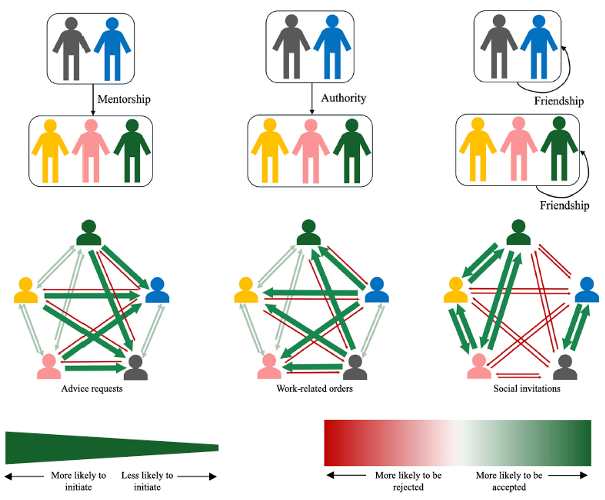
The paper is a stripped-down version of starting a new job and trying to figure out how everyone works together. People watched short animations of 6 to 8 social interactions between 5 people. Despite observing a small subset of the network, they correctly infer the group’s hierarchy and its friendship and mentorship networks, and they use these inferences to make novel predictions about interactions between unobserved elements of the network. Their predictions closely matched a Bayesian causal model that combines data from observed behavior with social theories like “social invitations are symmetric among friends” and “advice requests typically flow from mentee to mentor, but not the reverse”. Importantly, people didn’t need to observe much data, and they certainly didn’t need to explicitly map trillions of network combinations. They built and tested sparse causal models and easily generalized beyond them.
Even this study fails to capture the real-world complexity of social interaction. Relationships are more than just an accumulation of facts about people - they are shared histories of successful “grounding”. Over time, friends develop conversational shorthand, inside jokes and references, trust, expectations, and conversational taboos. The context of a single relationship is constantly evolving and requires multimodal (e.g. body language) learning from accumulated common ground. Importantly, social learning doesn’t scale easily, in the sense that building a deep relationship with one person doesn’t let you skip steps with others.
LLMs can’t overcome their learning inefficiency with brute force and extreme scale in social relationships, because they require continual learning and nurturing. And that is why I believe people will always have a comparative advantage in social interaction.
In next week’s post, I’ll tell you why I think social skills matter for economic production, and how the human edge in learning efficiency might translate into the jobs – and wages – of the future.
An important caveat – there needs to be some opportunity cost of the AI’s time and effort. Tom Cunningham have argued about this as recently as last week (hi Tom!). If AI has no energy cost and can replicate work infinitely and do everything all at once, the argument breaks down. Although AI is getting better and more efficient all the time, frontier models still need massive amounts of compute, workers are burning through their token budgets, and labs are raising prices to try and cover their costs. So at least for now, the comparative advantage logic still applies. It’s also true that the logic of comparative advantage doesn’t say anything about wages. Some people think AGI will cause wages to fall below subsistence level. I will take this up in more detail next week.
Pride - pride before the fall.
Important caveat - frontier models could already be better at these tasks. I was unable to find any recent research on social reasoning tasks that uses GPT-5 class models or Claude Fable.
The number of 1:1 relationships in a network scales quadratically. But if every pair can have a tie (meaning they are equal in a social hierarchy), an undirected network has 2n possible network structures, where n is the number of possible pairs. That translates into 26 = 64 possibilities for a group of 4 people (6 possible pairs), but 35 trillion possible structures for a group of 10 people (45 possible pairs, so 245).
Its great that you identify things that humans are better at than LLMs. However, you will simply not be able to make a decent living out of doing the things that humans are good at